


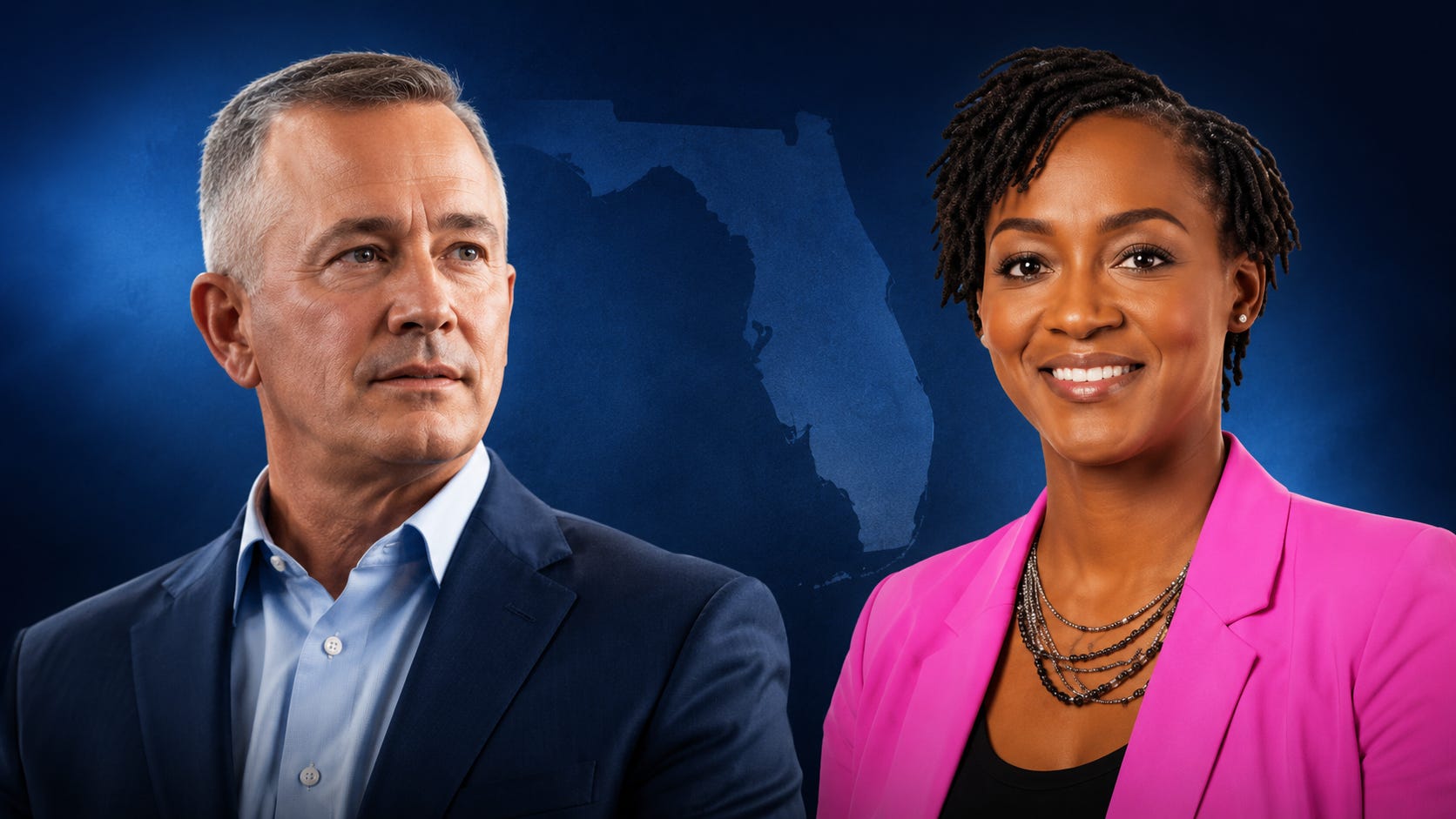
David Jolly and Angie Nixon, Florida’s Democratic nominees for governor and U.S. Senate.
For a long time, Democrats in Florida have been pondering a single question: What kind of Democrat has a chance of winning Florida?
It seems like the answer is yes, based on last week’s primary.
On one end of the statewide ticket is David Jolly, the Democratic nominee for governor. Jolly is a former Republican congressman who spent years as an independent before joining the Democratic Party. He openly calls himself a capitalist, rejects socialism, and has centered much of his campaign on affordability, property insurance, housing, health care, and education.
On the other end is Angie Nixon, the Democratic nominee for U.S. Senate. A Jacksonville state representative, she pulled off one of the biggest surprises of Florida’s primary by defeating the better-funded Alex Vindman. Nixon has joined the Democratic Socialists of America, though she has pushed back against being labeled simply a “socialist” and says she disagrees with parts of the organization’s platform.
So, just to recap: Florida Democrats nominated a former Republican for governor and a DSA member for U.S. Senate in the same election.
Florida politics said, “Why pick a lane when we can use the whole highway?”
But underneath the jokes is a fascinating political experiment.
An Axios analysis of precinct results found Nixon performed better in younger and more heavily Black areas, while Jolly’s support increased in older and whiter precincts. In other words, the two candidates may represent very different sections of the Democratic coalition.
That could be a disaster.
Or it could actually be the point.
For years, Democrats have debated whether winning requires moving toward the center to attract independents and moderate Republicans, or moving left to energize younger voters, working-class voters and people who normally stay home.
Florida Democrats are about to test both theories at the same time.
Jolly can walk into a room and tell skeptical voters, “I used to be a Republican.” Nixon can walk into another room and argue that the political system itself hasn’t delivered enough for working families.
They disagree on plenty. Jolly has explicitly rejected socialism and the DSA, while still praising Nixon as a fighter focused on economic issues. Nixon, meanwhile, has emphasized Medicare for All, affordable housing and economic inequality while distancing herself from some of the national DSA’s more controversial positions.
And Republicans have already noticed.
The Florida GOP is attempting to link Jolly and Nixon while making “socialism” a central issue in the November campaign, which is a particularly potent attack in South Florida, where the term carries significant historical and cultural weight for many Cuban, Venezuelan, and other Latin American voters.
That means Jolly and Nixon don’t just have to convince voters to support them.
They may have to convince voters to tolerate each other.
Still, there is one place where their messages overlap: Florida is expensive.
Housing. Insurance. Rent. Health care. Utilities. Groceries.
That may ultimately be the glue holding this very strange political marriage together. Florida Democratic leaders are already emphasizing affordability as the common ground connecting the party’s different wings.
The question heading into November isn’t whether Florida Democrats are moderate or progressive.
Clearly, they’re both.
The real question is whether the Jolly voter and the Nixon voter are willing to show up for the same team when it actually counts.
Because Florida Democrats may have just built either the broadest tent in state politics…
or the most awkward group project imaginable.
And November gets to grade it.
Can’t wait to see how the voters will turn up and out in November! Very interesting read and I am proud of you. #TeamNixon