


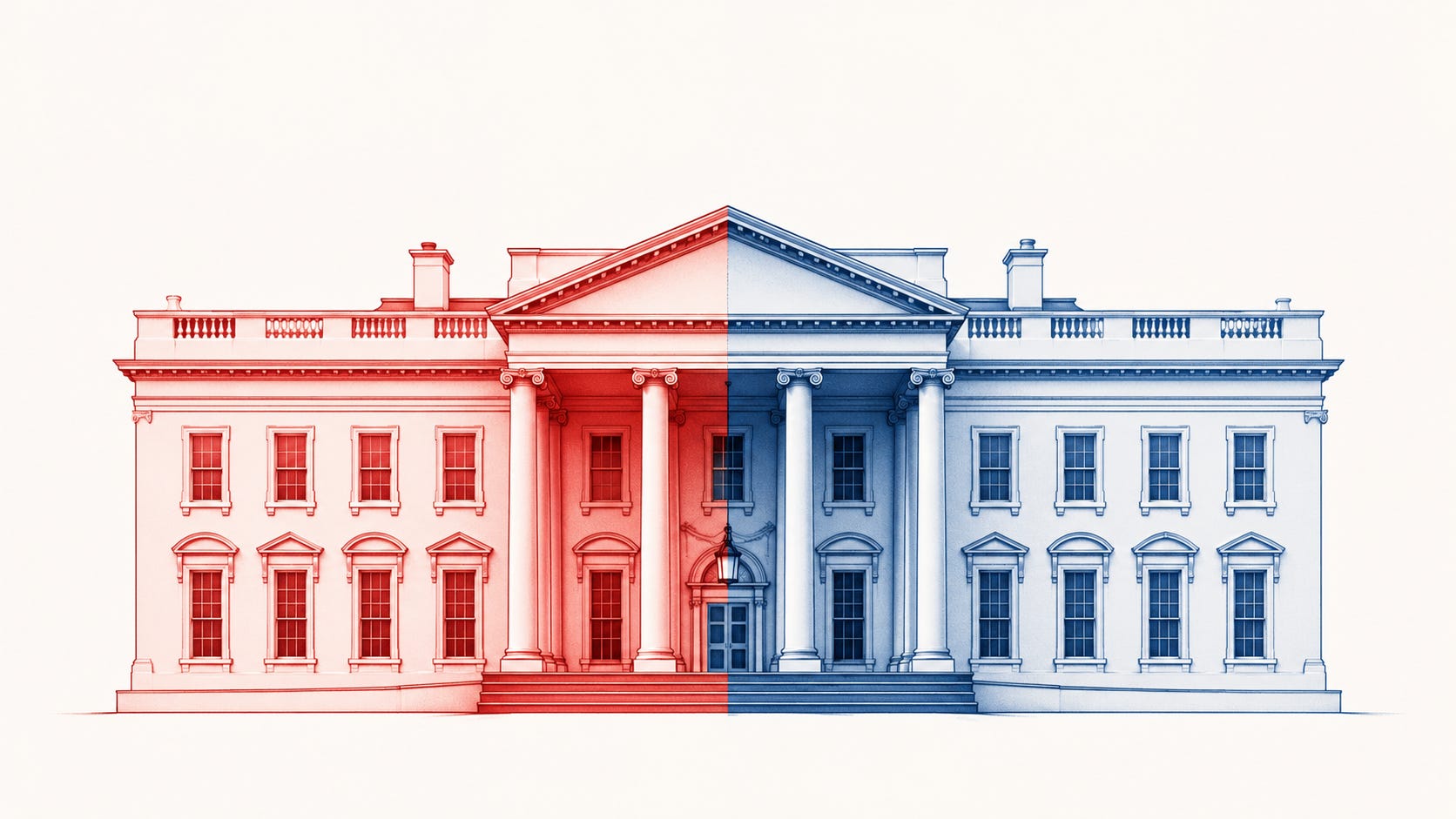
Spend ten minutes political Twitter, my fault, X and you would think America is days away from a civil war. Everybody is a fascist. Every election is “the most important of our lifetime.” And if a politician dares to compromise with the other side, someone online is immediately calling them a sellout.
Then you log off and talk to normal people.
Most of them are worried about rent, groceries, property insurance, health care, their kids’ schools,, and if their paycheck will make it to Friday. Ask those same people ten political questions, and you might get three answers that sound Democratic, four that sound Republican, and another three that don’t fit neatly into either party at all.
That, more than anything we see online, is probably a better picture of America.
Pew Research Center’s 2026 political typology found that most Americans fall somewhere in a broad and politically messy middle rather than neatly inside the country’s most ideological groups. Instead of simply separating the country into Democrats and Republicans, Pew identified nine different political groups, many of which hold views that cross traditional party lines.
And that honestly makes sense because people have always been more complicated than political parties make them seem.
You know the person who supports abortion rights but owns five guns. The auntie who votes Democrat every election but thinks Democrats have completely lost their minds on one particular issue. The Republican who wants lower taxes but cannot stand Donald Trump. The voter who wants stronger border security but also believes immigrants who have built lives here should have some legal path forward.
Good luck fitting all of that on a bumper sticker.
The Middle is Still Here
What makes this conversation interesting is that the political middle has not disappeared nearly as much as our politics makes it seem.
Gallup reported in January that a record 45% of Americans identified as political independents in 2025, higher than the share identifying with either major party. When Americans were asked about ideology, 35% described themselves as conservative, 33% as moderate and 28% as liberal. Among independents, nearly half called themselves moderate.
So no, the entire country has not split into democratic socialists on one side and MAGA Republicans on the other.
But sometimes our politics certainly feels that way, and there is a reason for that. Having more people does not automatically mean having more political influence. You still have to participate.
Pew identified one group it calls the “Tuned-Out Middle.” More than half of the people in that group describe themselves as moderate. Their views do not follow a clean party script either. They are somewhat liberal on certain economic questions, more conservative on some cultural issues and somewhere around the middle on things like immigration.
That probably sounds familiar because almost everybody knows somebody like that.
The problem is that only 32% of the Tuned-Out Middle voted in the 2024 election, the lowest turnout of any of Pew’s nine political groups. Just 19% said they follow the news all or most of the time.
And I think that explains a lot of what we are seeing.
The political center did not disappear. It got quieter.
The People on the Edges Show Up
Politics rewards participation. People who vote in primaries matter. People who donate matter. People who volunteer, organize, call lawmakers, attend meetings and spend their Tuesday night arguing about a congressional amendment that 97% of the country has never heard of matter too.
The people most deeply involved in politics also tend to have the strongest political identities.
That creates a pretty simple problem. Imagine ten people sitting in a room, but only three of them ever raise their hands. Eventually, whoever is running the room is going to start paying a lot more attention to those three people.
That is basically what politics does.
The politically exhausted middle may still be large, but the most ideological voters are often louder, more organized and more reliable. They vote in low-turnout primaries. They donate. They volunteer. They show up at party meetings. They flood comment sections and make their opinions impossible to ignore.
Then everybody else looks around and wonders why politicians do not sound like them anymore.
Social media makes that problem worse because outrage performs better than nuance. A politician can post a thoughtful explanation acknowledging that both sides of an issue have legitimate concerns and maybe get nine likes. Somebody else can post that America is collapsing, the other party hates the country and anybody who disagrees is evil, and suddenly everybody is quote-tweeting it.
That is not because most Americans necessarily believe the most outrageous thing being said. It is because outrage gets attention, attention creates engagement, engagement creates followers and followers can turn into votes, donations and influence.
Both Parties Have Their Version of This
This is not a “Democrats are crazy” argument or a “Republicans are crazy” argument. Both parties have very powerful factions that can shape the direction of the larger coalition.
On the Republican side, the MAGA movement showed just how much a motivated base could reshape an entire political party. Republicans who once sounded more like traditional business conservatives increasingly found themselves operating inside a party dominated by populism, immigration, cultural issues and loyalty to Donald Trump.
On the Democratic side, progressives have pushed issues like economic inequality, health care, climate policy, policing, Gaza and corporate power much further into the center of the party’s conversation.
That does not mean every Republican voter suddenly became MAGA, and it certainly does not mean every Democrat became a socialist. It means the people who care the most, organize the hardest and show up the most consistently tend to have an outsized influence on what their parties talk about.
Meanwhile, millions of Americans are basically sitting at home saying, “I don’t really like either one of y’all.”
Gallup’s finding that 45% of Americans now identify as independents should probably be flashing like a warning light on both parties’ dashboards.
Instead, independents and moderates are often treated like people politicians will worry about after the primary is over and somebody suddenly remembers there is a general election coming.
Moderate Does Not Mean You Believe Nothing
Another problem is that “moderate” has almost become an insult in modern politics.
People hear the word and imagine somebody who has no convictions, never takes a position and just wants everybody to hold hands in the middle of the Senate chamber.
That is not what being moderate means for most people.
Sometimes it simply means your beliefs do not fit neatly inside one party’s box.
You can believe corporations should pay more in taxes while also thinking government wastes too much money. You can support police officers and still believe police departments need accountability. You can believe the immigration system is broken without believing every immigrant is some kind of threat. You can support LGBTQ Americans while disagreeing with parts of the progressive movement on certain cultural questions.
You can also be deeply religious without believing your pastor should be writing federal law.
Regular people have always held combinations of beliefs like these. Political parties are the ones that try to convince us every issue has to come bundled together.
Pew’s research reflects that reality. Its political typology includes groups that lean Republican while holding traditionally Democratic positions on certain issues, as well as Democratic-leaning groups that are much more conservative than the party’s progressive wing on others.
America is complicated. Our political branding just is not.
The Middle Has Some Responsibility Too
It is easy for moderate and independent voters to say nobody represents them, and sometimes that criticism is completely fair. But there is another part of the conversation that people may not want to hear.
Politicians listen to people who participate.
If moderate voters continue checking out while ideological voters keep checking in, the result should not surprise anybody. The people who show up are eventually going to have more control over the menu.
You cannot leave the restaurant, let everybody else order for the table, come back twenty minutes later and get mad because nobody ordered your wings.
Politics works the same way.
If moderates want more moderate candidates, they have to vote in primaries. If independents want politicians to listen to them, they have to organize around issues they care about. If people are tired of the loudest voices controlling everything, then the quieter voices have to start showing up too.
And heading into the 2026 midterms, that could matter a lot. In Pew’s July polling, 43% of registered voters in the Tuned-Out Middle either preferred another candidate or were not sure whom they would support for the House.
That is a lot of voters who are not fully committed.
For either party, that should look less like a problem and more like an opportunity.
The party that figures out how to talk to people who do not spend their entire day thinking about politics could have a major advantage. Not by standing for nothing and not by pretending every issue has an easy middle-ground solution, but by remembering that most Americans are not asking their politicians to win arguments online.
They are asking them to make life work.
They want housing they can afford, safe communities, decent schools, reasonable health care costs, a functioning immigration system and leaders who can disagree without acting like every disagreement is the fall of Rome.
America is not nearly as politically neat as our timelines make it look. There are conservatives with liberal opinions, liberals with conservative opinions, independents who consistently lean toward one party and millions of people who mostly want Washington to stop acting like Thanksgiving dinner five minutes after somebody’s uncle brings up politics.
The political extremes are not necessarily winning because the entire country suddenly moved to the edges.
A lot of the time, they are winning because they are organized, engaged and loud.
Meanwhile, everybody else left the microphone unattended.
The center did not disappear.
It just got quieter.
Maybe it is time it started talking again.